
Distribution
Your own booking page, priced by the same engine as the desk
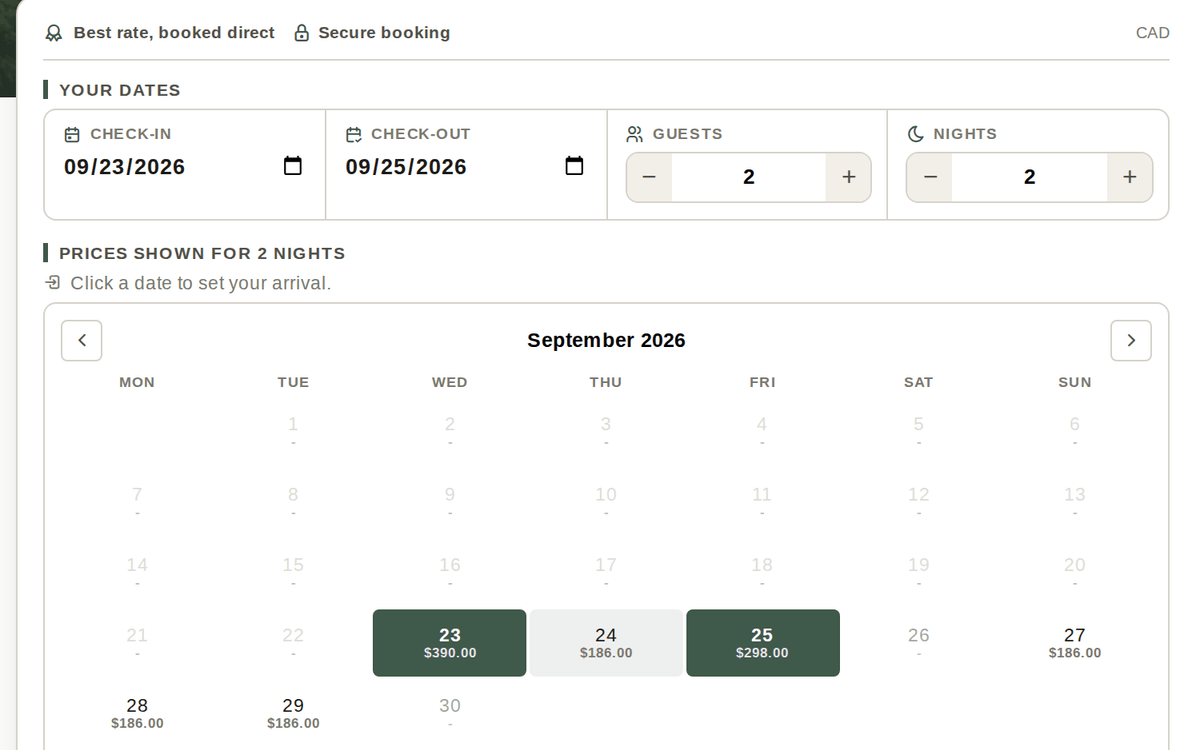
A booking page included in your plan, at zero commission. Cardinal builds it from your property data, and every booking lands straight in the calendar your desk uses.
Direct booking
What the guest sees
Your property, not a template
Your photo, description, amenities and policy, on a mobile-friendly page with no account to create.
One calendar, so there is nothing to sync
The page books straight into the database the desk uses. A room sold at the desk is gone from the page the same instant, and the page uses the same prices as the desk, so the total the guest is quoted is the folio total to the cent.
Stays and activities in one flow
A guest can add a guided hike to their stay without a second checkout.
A link and an embed
Share the link, or embed the page in the site you already have.
Channels
Your calendar and theirs, kept in step both ways
A calendar feed out of every room, and the channels' own feeds read back in every hour. Availability is shared both ways, every hour, so a night sold anywhere is closed everywhere.
An iCal feed per room, which the channels already read
Airbnb, VRBO and Booking.com subscribe to a calendar feed for each room and stop selling the dates in it, so a closure reaches them without anyone retyping it. The feed carries dates and nothing else: no names, no amounts, not even a confirmation number. Each feed has a private link you can replace at any time, which cuts off every old copy.
Their bookings close your dates, every hour
Paste each channel's calendar link into Cardinal and it reads it every hour, closing the nights that channel has sold so the desk cannot sell them twice. A read that fails changes nothing: an outage on their side never reopens a night they are holding. The block is labelled with the channel it came from.
Room-type mapping and rate offsets
Set what each channel sells and at what offset from your own rates, channel by channel.
Commission modelled by who collects
Who collects the guest's money is a per-channel setting. A hotel-collect channel invoices you commission monthly; a merchant-model channel charges the guest, keeps its cut and remits net. Mixing them up means either asking a guest to pay twice or clearing a bill they still owe.
Amenities resolved, never guessed
You type amenities in plain language, and each one is matched against a list of 63 the booking sites recognise. What matches shows on your booking page with a French label and an icon you did not have to write, and is ready for the channels' own amenity lists. What does not match is labelled as showing on your booking page only. Nothing is guessed.
And it notices when a room fact is promised to the whole property
Type Fireplace into your property facilities and the screen says it reads as a room-type facility: listing it there promises one to every guest, including the ones in a room that has none. It offers to move it onto the room types that actually have it, and in that list the ones already carrying it are ticked and locked, so it cannot be listed twice. A room type that words it differently counts as already having it. Your own wording moves with it, and you can always leave it where it is. Over-promising an amenity is not a validation error. It is a guest at the desk asking where the fireplace is.
An unrecognized amenity says it shows on your booking page only. Software that guesses has to be double-checked.
Questions
Asked and answered
Do I get a direct booking page?
Yes. Hosted, no login for the guest, mobile-friendly, showing your photos, description, amenities and policy. It prices through the same rate engine the desk uses and writes a real reservation. Commission-free.
Can guests book activities online?
Yes, on the same page as the stay.
Do you connect to Booking.com and Expedia?
Availability travels both ways today. Each room publishes a calendar feed that Airbnb, VRBO and Booking.com subscribe to, so dates you close here stop being sold there, and Cardinal reads their feeds back every hour and closes the nights they have sold. The feeds carry dates and nothing else. Underneath you map room types, set a rate offset per channel, and record who collects the guest's money, so each channel's commission lands on the right folio.
Do you track OTA commission?
Yes, and it is modelled properly. Who collects the guest's money is a per-channel setting, because it changes everything: a hotel-collect channel invoices you commission monthly, while a merchant-model channel charges the guest, keeps its cut and remits net. Conflating those either chases a guest for money they already paid or zeroes a folio the guest genuinely owes.
What about amenities for OTA listings?
You type them in plain language. Each one is matched against the list the booking sites recognise: what matches gets a French label and an icon for free and is ready for the channels' own lists, what does not is labelled as showing on your booking page only. That is why you do not fill in a 200 item checklist here. If something you typed at property level is really a room fact, a fireplace say, the screen says so and offers to move it onto the room types that have it.
Next
Read this next
Rates
Type one price and every rate plan follows it, and the guest always gets the lowest rate that applies.
Activities
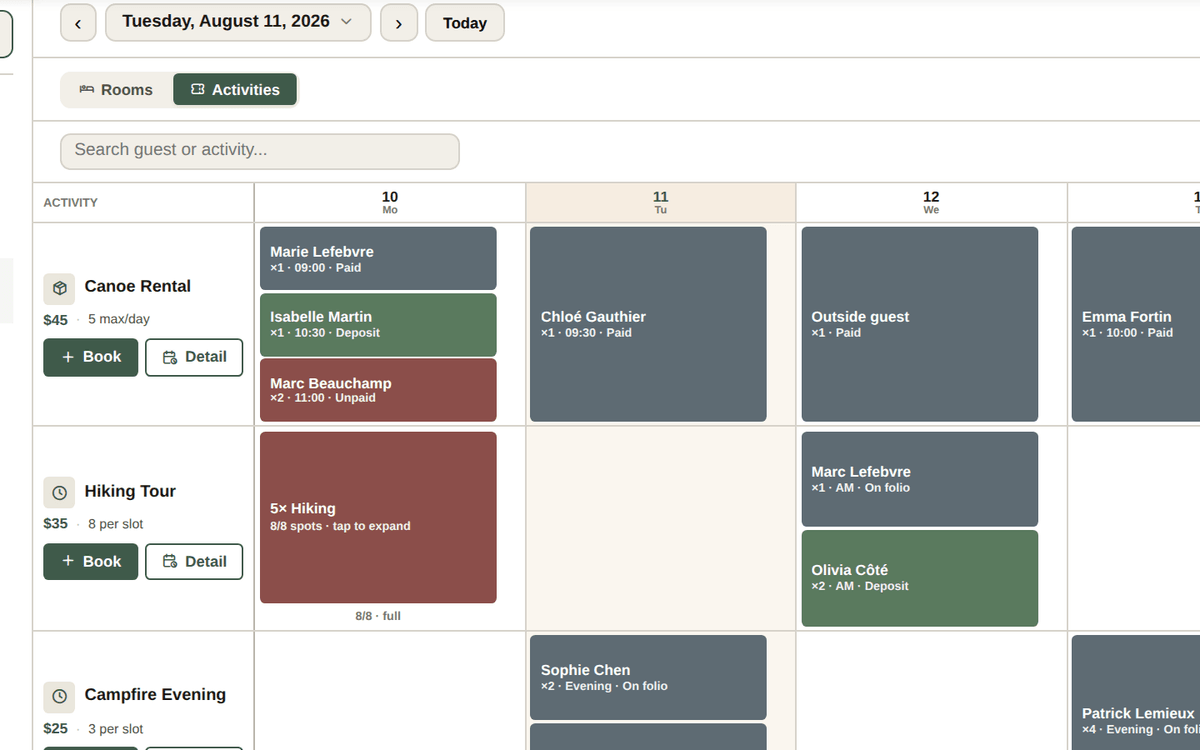
All your activity reservations as a calendar or a list, each with its payment colour and its next step, billed to the guest's room.
Corporate accounts
Company accounts with their own balance, aging by company, and travel agencies that are never billed by mistake.
See it running
Follow a full day in Cardinal, screen by screen.
Six real screens from a working property, in the order the day happens. Open it now and go at your own pace.