
Front desk
The reservation and the bill are the same screen
There is no separate folio module to open and reconcile against. The booking, its lifecycle, its charges and its balance are one surface, and every other screen derives its status from the same rule.
Rooms by dates, with nightly rates on the bars themselves. One click on a bar opens the stay; the board stays where it was.
The reservation
A lifecycle the whole system agrees on
Seven states, and every screen reads the same one
Pending, guaranteed, confirmed, in-house, departing, checked out, settled. A stay is in exactly one of them at a time and the move from one to the next is a rule rather than a field somebody sets. So the calendar, the day's task list and the folio can never disagree about a guest, and neither can two people looking at different screens.
A step nobody did says so, instead of going quiet
The folio draws the whole stay as one line, from taking the booking through to checking out, with the step you are on marked and the ones still ahead carrying the action they need. The unusual part is the step that got passed over. Check a guest in without ever taking a card and Take guarantee does not turn the same colour as the steps that really happened: it is marked as skipped, in its own colour, and it says the guarantee was never collected. Most systems have room for done and not done only, so a guarantee nobody took looks exactly like one that was, and you find out at check-out. The line takes its colour from the state the stay is in, so a guest who owes money does not read like a guest who simply has not left yet.
Readable from across the room
Every booking card carries one colour for where the stay is, on its pill, its bar and its buttons, and a strip with one block per night that fills as the stay goes: Night 2 of 4. When something has to happen first, such as another guest still holding the room, the colour says that instead until it is done, then goes back.
Or read it as a list, sorted by what needs you
The same bookings as a list in three groups: Today's Guests, Outstanding balance, All bookings. Filters narrow it to arrivals, departures, in-house, upcoming, cancelled or owing.
Missed arrivals are a state, not an overdue date
A no-show gets its own colour and its own actions: check in late, or update the arrival date, or cancel with cancellation-fee guidance.
Overnight resolution, quietly
A guest who never arrived is auto-cancelled after a 24 hour grace window and their charges reversed in the ledger. A guest who never checked out is auto-checked-out. Both are written to the activity log rather than left as a banner nagging the desk in the morning.
Drag to create, drag to extend
Drag a date range across a room to open a prefilled reservation. Drag a booking's edge to extend or shorten a stay, with a confirmation that shows the exact folio change before it applies.
Late check-out, where the stay is
Sold from the reservation by the hour, and only for as many hours as the room is free before the next arrival. The bar on the board stretches to match.
Extras go on while the booking is being taken
Add-ons, packages and activities are chosen inside the reservation, on the days of the stay, with a quantity per day and the places left shown on each one. A one-time inclusion can be pinned to the day it is actually delivered, and that is the day the service sheet reads. It is the conversation you are already having with the guest rather than a second one later.
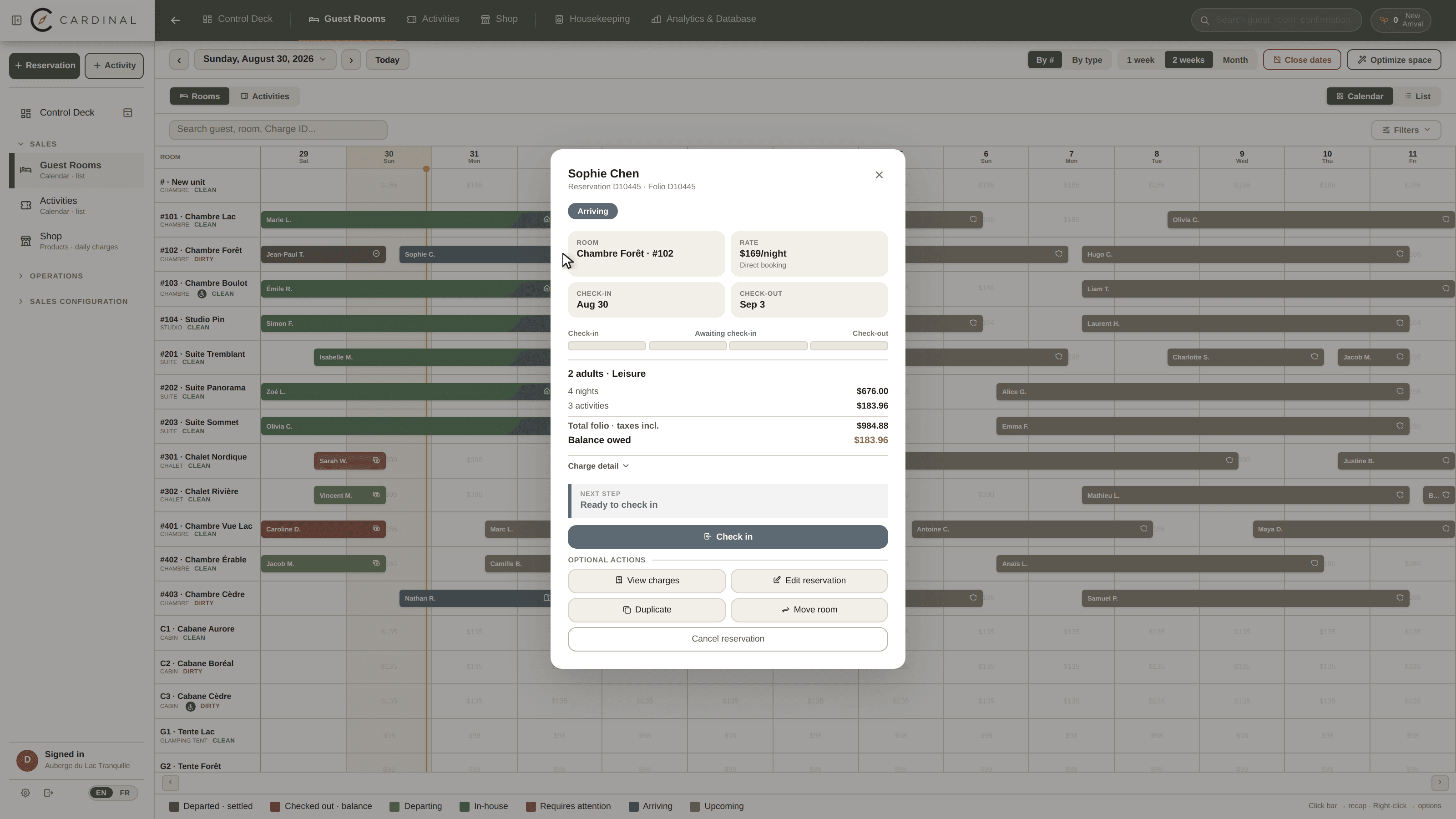
One click on a bar opens the recap. The next step is derived from the state the stay is in, and the alternatives sit under it rather than competing with it.
Guards
The mistakes that cost money are blocked, not logged
A guard that only writes a warning to a report is a guard that failed.
Room conflict
The system refuses a check-in into a room another guest still occupies, and names who to check out first with a direct link to their reservation.
Dirty room
Checking a guest into a room that has not been cleaned since the last guest raises a soft warning you can override. A quick tidy for an early arrival is legitimate.
Out of order, everywhere at once
An out-of-order room is unbookable in the booking wizard, the public booking page, auto-assign, room moves and week optimization. They all read the same flag. And it comes back dirty rather than clean, because a room somebody has had the carpet up in is not ready for a guest just because the work finished.
A guarantee you can act on
If no card is vaulted, the system says so rather than displaying a card that does not exist. A guarantee that cannot be collected is never shown as secured.
Full is answered before you have chosen anything
The dates step says how many rooms are free for those exact dates before you pick one, and names the categories that are out and why, booked or too small for the party. Duplicate a stay onto a week that is already full and it does not just refuse: it says no room is free for the whole stay and offers the nearest date windows that are, as buttons that set the dates for you.
One search, so nobody creates the same guest twice
Name, email or phone, and the phone matches on digits alone, so 514-555-0123 and 5145550123 are the same question. The reservation wizard, the activity wizard, the global search and the guest database all call the same function, which means a guest who exists is found on every screen. A search that answers differently on two screens is how a duplicate guest record gets made: the person at the desk concludes they are not in there and types them in again.
Every number on the bill is a line you can point at. A charge, a payment, a correction, an amount moved to a company account: four lines in the order they happened, and the balance is their sum. Nothing on the screen arrived by an adjustment nobody can see, so any figure a guest questions can be read back to them off the same screen they are looking at.
The recap, its charges, and a check-in run from inside the folio. There is no second module to open and reconcile against.
The folio
One continuous statement, whatever happens to the stay
- Mid-stay room moves
- The move cuts the stay at today, closes the original segment and opens a new one. The folio still shows one continuous statement across both rooms with one running balance, carrying the price difference on the nights that are left, so the guest gets one bill for one stay rather than two that have to be added up.
- Automatic sub-folios
- Charges group into A lodging, B activities and products, C other, shown as dividers in one statement rather than as tabs you have to hunt through.
- Split settlement, walked one step at a time
- Where the room sits on one method and the extras on another, settling opens as a sequence rather than a puzzle: Step 1 of 2, the room on the card on file, then Step 2, the activities in cash. The order starts from the screen the operator came in on. One method for the whole folio stays one step, as before.
- Issue a refund appears when the money says so
- It is not a menu item to hunt for and not one to reach by accident. When voids or discounts leave the folio in credit, paying the guest back becomes the primary action on the screen, and the destination follows who is actually holding the money: on a channel-collect stay the desk can only return what the desk collected.
- Transfer a charge
- Move a charge to another in-house guest's folio, in whole or in part, with an undo.
- Multi-room and multi-type bookings
- One booking can span several rooms across different room types at their own rates, with one guarantee distributed correctly across the folios.
- A printable registration sheet
- Property legal name, GST and QST registration numbers, stay details, guarantee, policy text and a signature block, produced at check-in.
Payment method is chosen by business rule, not typed into a free-text field. Cash cannot guarantee a reservation. Cheque is available where a company settles a receivable, not as a guest tender. Company accounts receivable is a guarantee, not a tender.
Questions
Asked and answered
What happens when a guest does not show up?
The reservation is flagged as a missed arrival with its own colour and its own actions. If they are a day late, the action is check in late. Beyond that it is update arrival date and check in, or cancel, with cancellation-fee guidance. If nothing resolves it, the system auto-cancels after a 24 hour grace period and reverses the charges in the ledger.
What if a guest does not check out?
They are auto-checked-out after the same grace period, with the balance left exactly as it stands.
Can I stop someone checking a guest into an occupied room?
It is already blocked. The system names the guest who has to be checked out first and links straight to their reservation.
Does it know if a room is clean?
Yes. Checking a guest into a room that has not been cleaned since the last guest raises a warning you can override. A quick tidy for an early arrival is legitimate, an accident is not. Rooms marked dirty stay dirty until someone cleans them, including overnight.
Can the room go on the company account while the guest pays for their own extras?
Yes. Charges group automatically into lodging, activities and products, and other. Each group can settle on its own method. One reservation, two settlements, one screen.
Can I move a charge to another guest's folio?
Yes. The whole charge or part of it, to any in-house guest, with an undo.
Next
Read this next
Accounting and tax
An append-only ledger, per-component tax, period close. A book of account, not a balance field.
Housekeeping and assignment
Priority derived from movements, a staffing forecast, and room assignment that spreads wear.
Corporate accounts
A city ledger, aging by company, and an agency model that cannot invoice the wrong party.
See it running
Watch a day run before you talk to anyone.
Six real screens from a working property, in the order the day happens. Open it now and go at your own pace.