
Compliance
Three taxes, and three different rules about who remits them
An American system treats tax as a percentage. In Canada the sales tax alone arrives in three different combinations depending on the province, accommodation tax is a separate thing again, and in some provinces who remits it changes with the booking source. The workarounds are where the money leaks.
The model
Canadian tax, built into every charge
Derived from your address
Enter a postal code and the province, the tax table and the timezone are all set correctly. There is no tax percentage field to guess at.
Stored per component
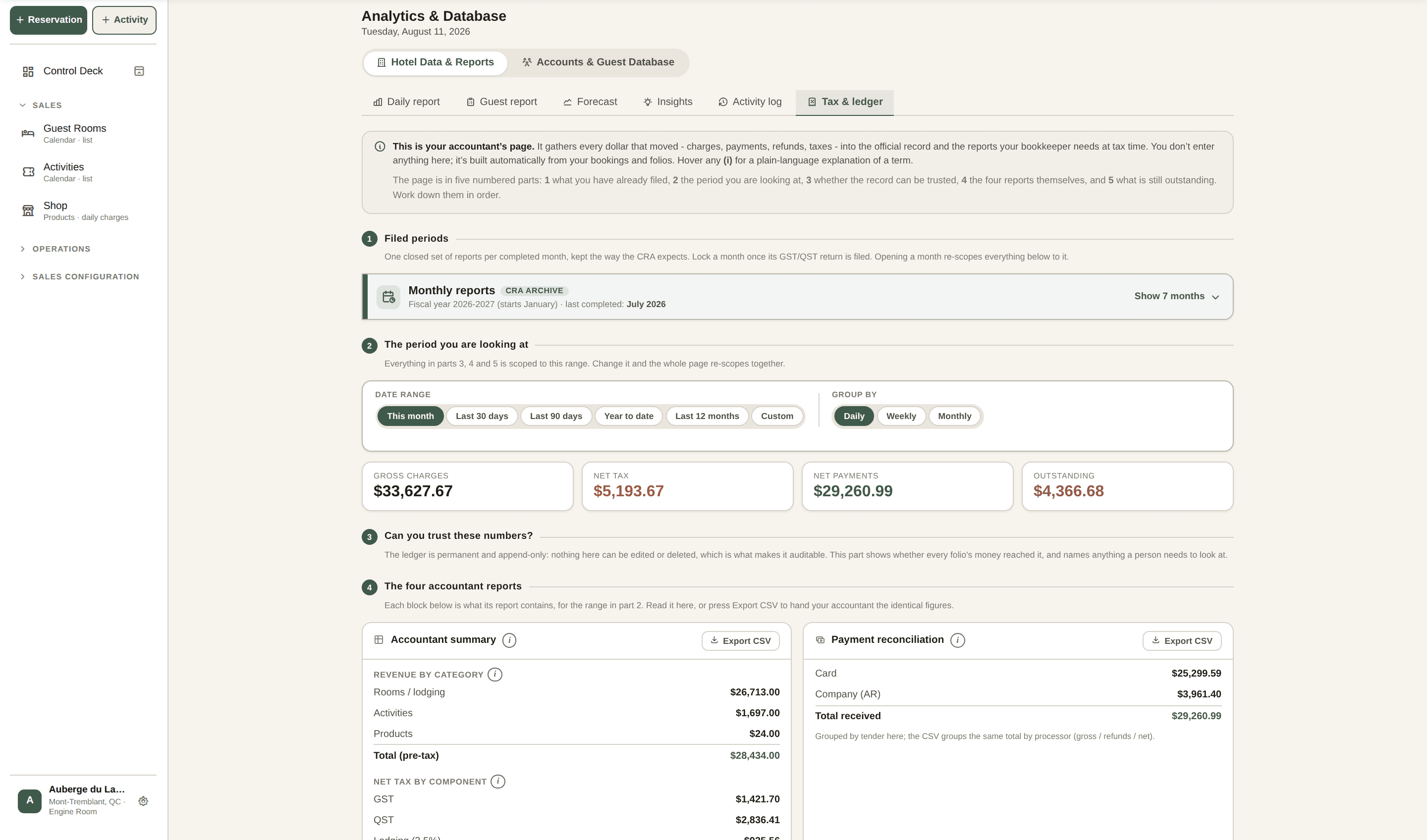
GST, QST, PST, HST and lodging tax are separate columns on every posting. The remittance report is a query against those columns, not a reconstruction from a total.
Lodging tax on accommodation only
Never on goods, never on activities. This is the distinction most generic systems get wrong, and it is the one an auditor notices.
Dated in your timezone
Not the server's, not the browser's. A payment taken at 9pm on June 30 lands in June's return.
Your registration numbers, printed
GST and QST registration numbers appear on invoices and on the guest registration sheet, as required of a registrant.
The same screen is two documents
Before check-out a folio identifies itself as a proforma and treats money taken as an advance deposit. After check-out it becomes a tax invoice, with the registrant header, an invoice number and a date. They are two different documents under Canadian rules and most systems at this size print one.
Interac as a first-class tender
Debit and e-Transfer alongside card, cash and cheque, because that is what Canadian guests actually pay with.
One night, stored two ways
Tax stored per component, 18.48
Remittance report: queried
Every posting carries its own tax columns. The remittance report is a query against them, and the Quebec intermediary split is a column too.
Tax held as one blended amount, 18.48
Remittance report: reconstructed
Tax is a percentage applied to a total. Splitting it again at filing time is a reconstruction, and a reconstruction can be wrong.
Coverage
All 13 provinces and territories, with the right combination
Which taxes apply is a fact about where you are. What they cost changes, so your rates are yours to set and yours to update the day a municipality moves one.
| Province or territory | Sales tax | Accommodation tax |
|---|---|---|
| Alberta | GST | Your rate |
| British Columbia | GST + PST | Your rate |
| Manitoba | GST + RST | Your rate |
| New Brunswick | HST | Your rate |
| Newfoundland and Labrador | HST | Your rate |
| Northwest Territories | GST | Your rate |
| Nova Scotia | HST | Your rate |
| Nunavut | GST | Your rate |
| Ontario | HST | Your rate |
| Prince Edward Island | HST | Your rate |
| Quebec | GST + QST | Your rate, plus the intermediary rule |
| Saskatchewan | GST + PST | Your rate |
| Yukon | GST | Your rate |
Lodging and destination-marketing rates vary by municipality and change. Cardinal ships province-level defaults for the sales taxes and asks you to configure your accommodation tax rate, because that is the number only you can know.
Provincial specifics
The intermediary rule, modelled
In Quebec the accommodation tax works differently depending on how the guest reached you. Most systems collect one percentage and leave the operator to sort it out at filing time.
| Booked through | Lodging tax charged | Remitted by |
|---|---|---|
| Direct, at the desk or on your booking page | Your percentage rate | You |
| A traditional travel agency | A flat $3.50 per room-night | The agency |
| A registered digital platform | Your percentage rate | The platform |
A stay booked through an agency is not a stay you owe the accommodation tax on. Your report should already know that.
Arithmetic
Rounded per night, so it foots to the cent
Room tax is rounded per night and summed, rather than computed on the stay total. That is what makes the ledger match the printed invoice exactly, on every screen: quote, folio, ledger and export.
| Per night | Rate | Amount |
|---|---|---|
| Room | $169.00 | |
| GST | 5% | $8.45 |
| QST | 9.975% | $16.86 |
| Lodging tax | 3.5% | $5.92 |
| Night total | $200.23 | |
| Four nights | $800.92 |
Every figure a guest or an accountant sees comes from the same postings. The server re-derives each charge from the stay and the property's saved tax configuration and refuses anything that does not reproduce, so the browser never decides what the books say.
Filing
What comes out at the end of the month
- A GST and QST remittance report: collected, minus adjustments, equals net owing
- Accommodation tax split by who remits it
- A detailed transaction export with tax split by component
- An accountant summary and a payment reconciliation
- A monthly archive keeping all four reports for every completed month
- Period close, so a filed month cannot be changed underneath you
Questions
Tax, answered plainly
Does it handle GST, HST, QST and PST?
All of them, all 13 provinces and territories, with the correct combination for each, and stored as separate components on every transaction, so the remittance report is a query rather than a reconstruction.
What about lodging tax?
Applied to accommodation only, never to goods or activities. You set your rate. Quebec's intermediary rule is modelled: agency bookings carry the flat per-night amount remitted by the agency, platform bookings are remitted by the platform, and the remittance report splits the accommodation tax by who actually remits it.
Can I close a month so nobody changes filed numbers?
Yes. Close the period and it is locked. A transaction dated into a closed period is not rejected and is not lost. It is redated into the current period, with its original date kept on the record.
What does my accountant get?
A detailed transaction export with tax split by component, an accountant summary, a GST/QST remittance report, a payment reconciliation, and a monthly archive that keeps all four for every completed month. GL codes are configurable and mapped at export.
Where is my data stored?
In Canada. Relevant to PIPEDA and to Quebec's Law 25.
Do you back up?
Daily, with each month's first backup retained permanently, toward CRA's six year records requirement.
This page describes what the software does. It is not tax advice, and Cardinal is not a certification. Your accountant decides what these records mean for your filing.
See the numbers
Watch a remittance report build itself.
Bring a stay that crosses a month end and an agency booking. Those are the two that break other systems.